 Museum working hours: 10 a.m. to 6 p.m. daily.
For all questions and information we are at your disposal by landline +381 11 2651654 or e-mail: This email address is being protected from spambots. You need JavaScript enabled to view it..

 |
 |
 |
 |
 |
 |
 |


Museum working hours: 10 a.m. to 6 p.m. daily.
For all questions and information we are at your disposal by landline +381 11 2651654 or e-mail: This email address is being protected from spambots. You need JavaScript enabled to view it..
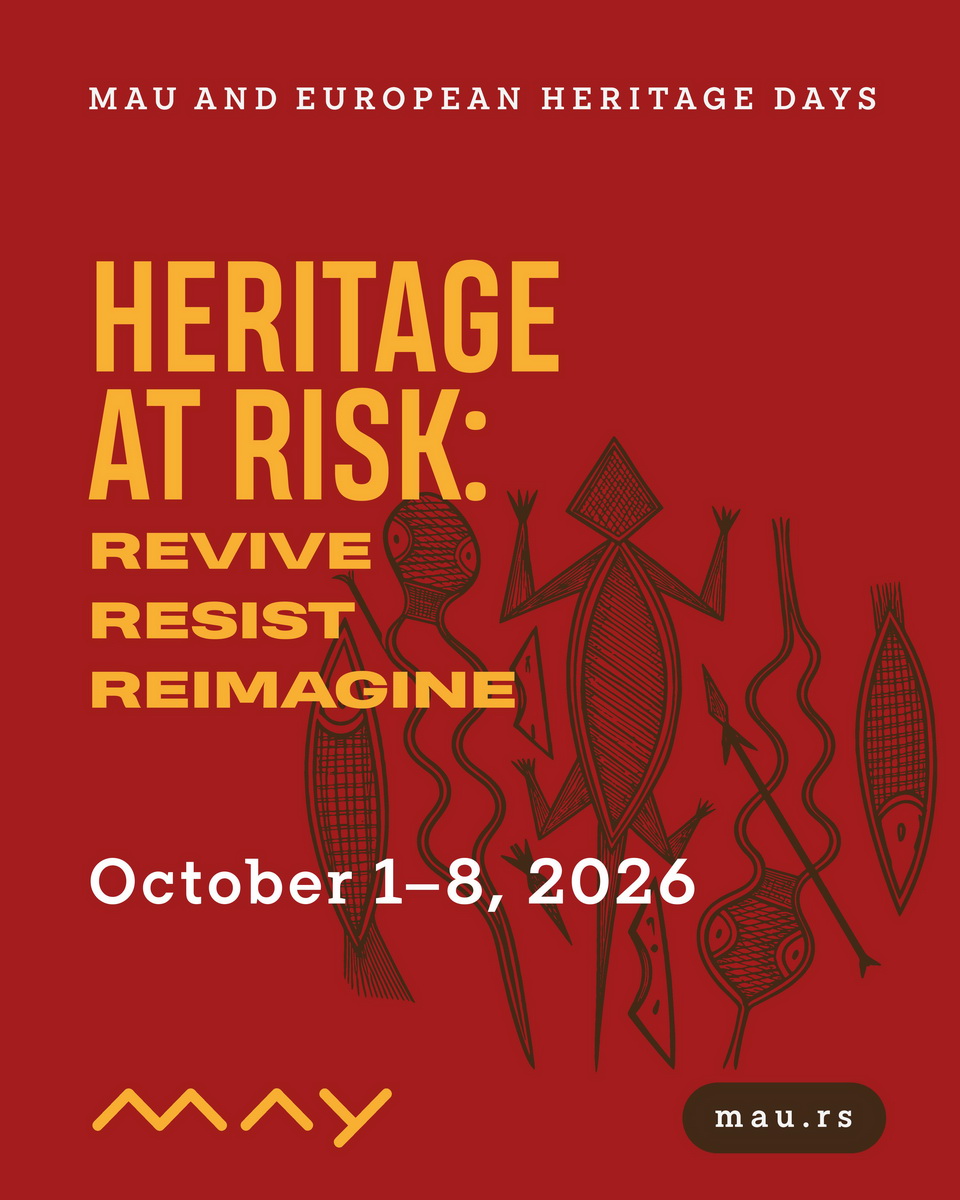 1-8 October 2026
The cultural heritage of African communities forms an integral part of contemporary European cultural and historical heritage. In this context, the African community in Belgrade holds a particularly important place. Its presence in the city is dynamic and growing, making a significant contribution to Belgrade’s cultural life, and particularly to the programmes and activities of the Museum of African Art.
As part of the European Heritage Days, the programme will explore themes of revival, preservation and transformation: local initiatives focused on transforming packaging waste into new and useful products; the relationship between oral tradition and contemporary identities in Mali and Kenya; the transformation of African artistic traditions in the contemporary practices of African artists; as well as a screening of The Time of the Leopard, an important work of Yugoslav cinema.
Through different perspectives, the programme will explore how cultural heritage is transmitted, reinterpreted and transformed, the ways in which it “lives” and the cultural spaces in which it takes shape, while also raising questions about the place of African cultures and communities in shaping the contemporary European cultural space. We invite audiences to actively engage with the programme, participate in the lectures and discussions, and contribute to a collective reflection on these issues through their questions and comments.
*Admission to all events within the European Heritage Days programme is free.
Travelling exhibition
 Castle of Culture (Zamak kulture)
Exhibition opening: 30 September 2026 at 2 p.m.
The exhibition Kanga - The Talkin Cloths, created by the Museum of African Art in Belgrade, will be on view at the Castle of Culture in Vrnjačka Banja throughout October and November this year. This presentation is organised in collaboration with the Cultural Centre of Vrnjačka Banja.
The exhibition is dedicated to kanga cloths—industrially produced fabrics in vibrant colours, with striking patterns and aphoristic sayings in Kiswahili. Kangas have been used in women’s clothing in East Africa for nearly 150 years, and have evolved into a ubiquitous symbol of Swahili culture. The display explores the various meanings and uses of kanga textiles, from their historical emergence as symbols of emancipation and modernity, through their communicative function within the “women’s domain,” to their contemporary reinterpretations in politics, ritual life, fashion, art and cultural practices.
The exhibition features original textiles from Kenya, Tanzania and the Republic of South Africa, fashion designs by Tanzanian designers Farouque Abdela and Christine Mhando, and paintings by Tanzanian artist Iddi Mikidadi Bush. The installation is complemented by a 13-minute documentary The Kanga Talks, based on the exhibition author’s research visit to Tanzania (Stone Town and Dar es Salaam) in September and October 2024.
Exhibition author: Aleksandra Bojović, Senior Curator
Thematic Exhibition
 Extended till October 11
Curator and catalogue author: Ivana Vojt, Senior Curator
The Museum of African Art presents its new thematic exhibition Recy: Art - Waste as a Resource, which foregrounds one of the most pressing global challenges: the consequences of the growing amount of waste and the possibilities of its transformation into a valuable resource.
Against the backdrop of accelerated urbanization, population growth, and shifting consumer habits that have dramatically increased waste across the African continent, the exhibition showcases creative responses by individuals, associations, and companies who turn this challenge into opportunity. At its core are utilitarian objects, jewellery, and souvenirs fashioned from industrial solid waste in Sub-Saharan Africa, bearing witness to innovative approaches to sustainability and economic ingenuity.
Rooted in the Museum’s collection - enriched since 1977 with works made from recycled materials—the exhibition has been significantly expanded with new acquisitions and donations from across Africa. Particularly noteworthy are objects gathered during field research in Tanzania in 2024, facilitated by touristic agency Disco Travel, alongside works from private collections and gifts from collaborators and friends of the Museum. On this occasion, the collection has grown by one hundred new pieces.
Program in the Garden of the Museum of African Art
 Extended till October 11
In the garden of the Museum of African Art, from May 20 to September 30, 2026, the program “Recy: Sculpt(H)ure-aay” will be realized, representing a accompanying segment of the ongoing exhibition “Recy: Art – Waste as a Resource,” authored and curated by Ivana Vojt.
The thematic exhibition of the Museum of African Art, “Recy: Art – Waste as a Resource,” showcases utilitarian objects, jewellery, and souvenirs made from discarded materials in Sub-Saharan Africa, highlighting one of the key global challenges – the growing amount of waste and the possibilities of transforming it into a valuable resource.
The accompanying program “Recy: Sculpt(H)ure-aay” in the museum courtyard presents artistic responses by three young local artists to the ongoing exhibition.
The authors, Marko Blanuša, Petar Božović, and Damjan Božović, graduated in applied sculpture at the Faculty of Applied Arts in Belgrade.
Virtual Tour
 The project of digitally recording the permanent display and whole Museum of African Art (MAU) building was conducted in several stages over the course of 2015, 2021 and 2022, with the aim of creating a so-called digital imprint as form of cultural heritage preservation. In light of the announced reconstruction of the Museum, by mapping all relevant data, we wanted to create lasting documentation of the initial architecture, as well as the concept of the first permanent display of the MAU. Recording the space and exhibition setting of the Museum using the most current technology and translating the data into a digital impression will make them permanently accessible to all future researchers and other interested parties, even when they cease to exist in their current state.
We invite you to actively explore our new online presentation www.otisak.mau.rs. Enjoy panoramic virtual walks through the museum, encounter the permanent display, museum garden or murals painted onto the façade, and investigate the many contents regarding exhibited pieces and collecting trajectories. Go back to 1977 and read about some of the impressions at the time of the opening of this lasting symbol of Non-Aligned times – a museum created on the grounds of friendship and sincere support of the peoples of Africa, and admiration for the power of their artistic expression.


| MAA is member of |  |

The Museum of African Art offers inclusive features such as access ramps for wheelchairs, guided paths for visually impaired visitors, and tactile objects with audio descriptions and Braille signatures.


